
Every restaurant owner knows the feeling.
7:30 PM.
Orders start flooding in.
Zomato notifications.
Swiggy orders.
Phone calls.
Walk-in customers are waiting.
The kitchen is under pressure, staff are rushing, and within minutes, the system turns into chaos.
Wrong orders get packed.
Delivery delays happen.
Customers get frustrated.
For multi-branch restaurants, this situation becomes even worse.
In 2026, restaurant owners are realizing that peak-hour chaos is not a staffing problem — it’s a system problem.
And the restaurants that are growing faster have already found the solution.
The Real Problem Behind Peak-Hour Chaos
Most restaurant chains still operate with fragmented order systems.
Orders come from multiple places:
- Food delivery apps
- Phone orders
- Walk-in customers
- Website orders
- WhatsApp orders
But the problem is that these orders are not managed in a single system.
Instead, staff manually copy orders, switch between devices, or depend on memory.
During rush hours, this leads to:
- Order duplication
- Kitchen confusion
- Delayed preparation
- Delivery partner waiting time
- Angry customers
For restaurants with multiple branches, the issue multiplies.
Orders may go to the wrong branch, or the nearest kitchen may not even know an order exists.
What Smart Restaurant Chains Are Doing in 2026
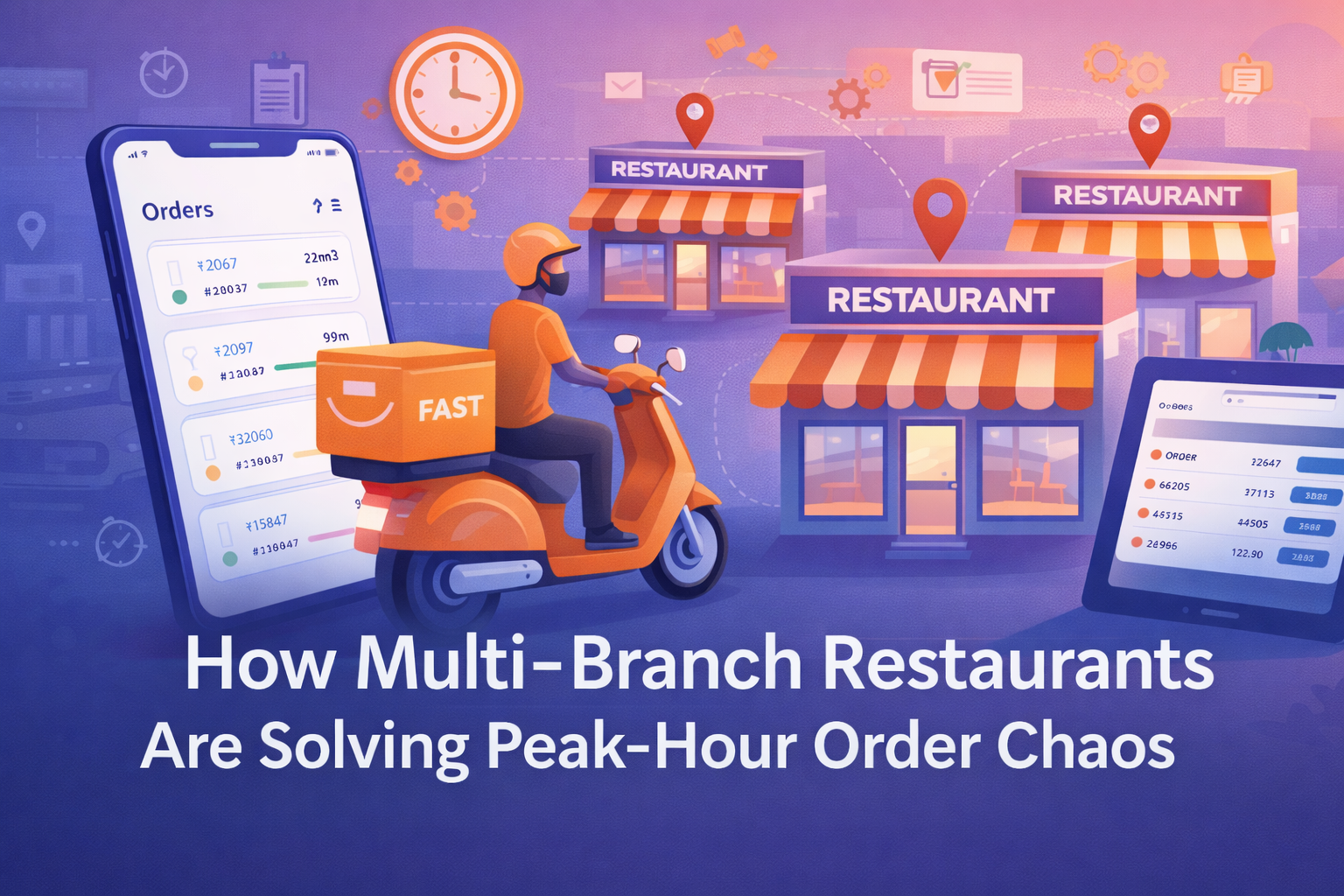
Successful restaurants are now moving toward centralized order management systems.
Instead of each branch operating separately, they connect all locations to a single intelligent platform.
This system automatically:
- Routes orders to the nearest branch
- Organizes kitchen workflows
- Assigns delivery partners efficiently
- Tracks order preparation in real time
The result?
Peak hours become organized instead of chaotic.
Kitchen staff focus on cooking.
Managers focus on operations.
Customers receive orders faster.
Why Multi-Branch Automation Matters More Than Ever
Customer expectations in 2026 are higher than ever.
People expect:
- Faster delivery
- Accurate orders
- Real-time tracking
- Consistent experience across branches
Without automation, restaurants struggle to meet these expectations.
But with the right system in place, restaurant chains gain powerful advantages:
1. Smart Branch Routing
Orders automatically go to the nearest or least busy branch.
2. Faster Kitchen Coordination
Kitchen staff sees clear digital order queues instead of paper slips.
3. Delivery Optimization
Delivery partners receive orders faster, reducing waiting time.
4. Unified Control for Owners
Restaurant owners can monitor all branches from a single dashboard.
The Hidden Cost of Manual Order Management
Many restaurant owners underestimate how much revenue is lost during rush hours.
A few common hidden losses include:
- Cancelled orders due to delays
- Incorrect orders that require refunds
- Staff stress and mistakes
- Poor customer reviews online
Even losing 10 orders per night during peak hours can result in thousands of dollars in lost revenue every month.
Automation doesn’t just reduce chaos — it protects revenue.
How Restaurants Are Scaling Faster with Automation
Modern restaurant chains are no longer treating technology as optional.
Instead, they are using custom restaurant management platforms designed specifically for multi-branch operations.
These systems allow restaurants to:
- Manage all branches from one admin panel
- Track sales and performance by location
- Assign delivery zones automatically
- Maintain consistent menus across locations
As a result, restaurants can expand from one branch to multiple locations without operational headaches.
The Future of Restaurant Operations
The restaurant industry is rapidly evolving.
In the next few years, successful restaurant brands will rely heavily on:
- automated order systems
- branch-based routing
- delivery tracking
- centralized dashboards
Restaurants that adopt these tools early will have a clear advantage over competitors.
Because when peak hours arrive, they won’t face chaos.
They’ll run like a well-coordinated system.
Final Thoughts
Peak-hour order chaos is not unavoidable.
It is simply a sign that the restaurant has outgrown manual operations.
In 2026, smart restaurant chains are solving this problem by adopting centralized technology designed for multi-branch businesses.
And the restaurants that do this are not only surviving the rush —
They are scaling faster than ever.
Was this helpful?
Related Posts